- formatting
- images
- links
- math
- code
- blockquotes
- external-services
•
•
•
•
•
•
-
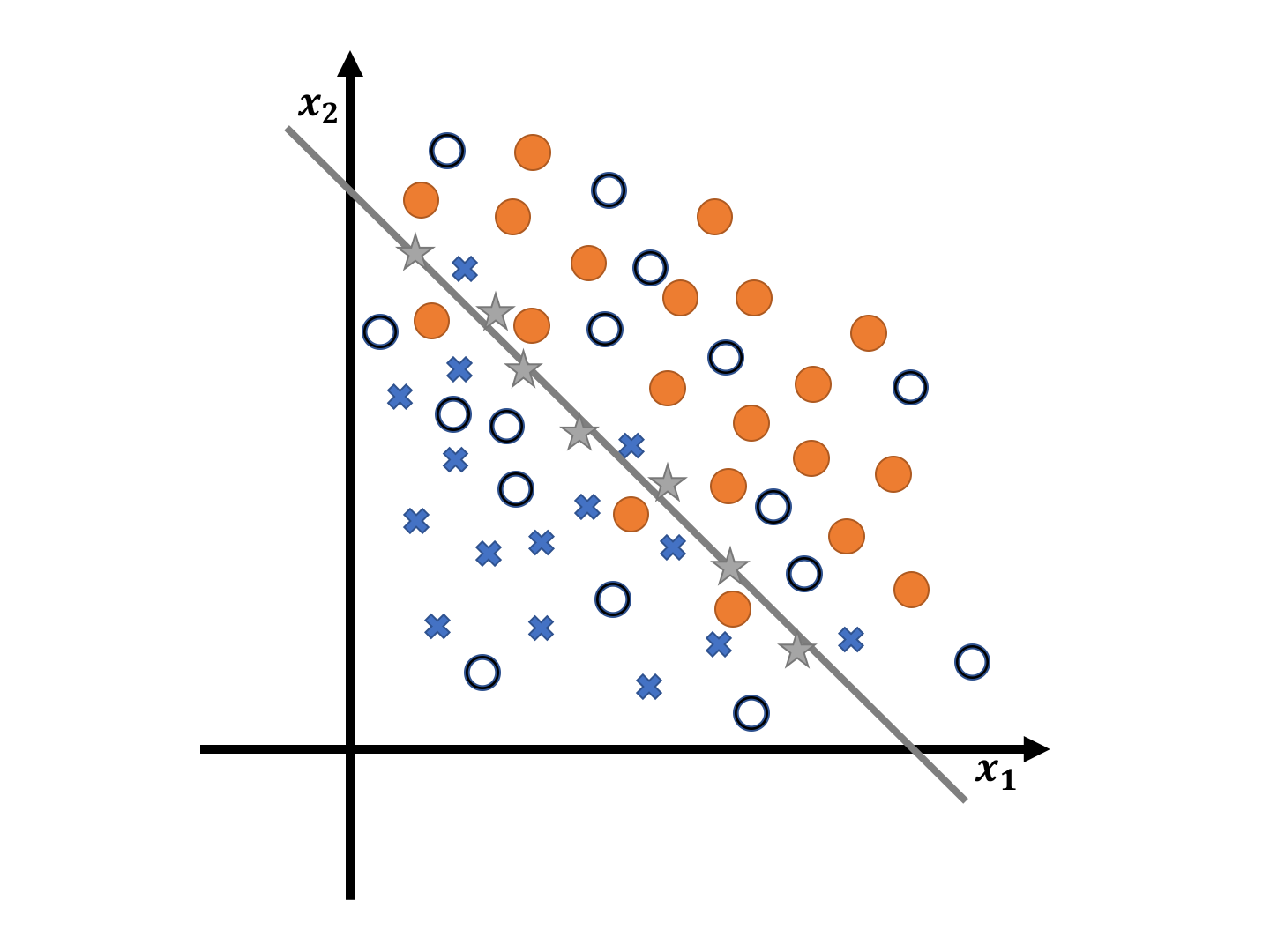
Constructing a Linear Classifier from Known Decision-Boundary Points
Construct a hyperplane from known decision-boundary points, use signed distances for classification, and extend the method to noisy boundary estimates with orthogonal least squares.
-
Derivation of a Weighted Recursive Linear Least Squares Estimator
Deriving a weighted recursive least squares estimator for batches of observations, with exponential forgetting and multiple outputs, together with its single-observation special case.
-
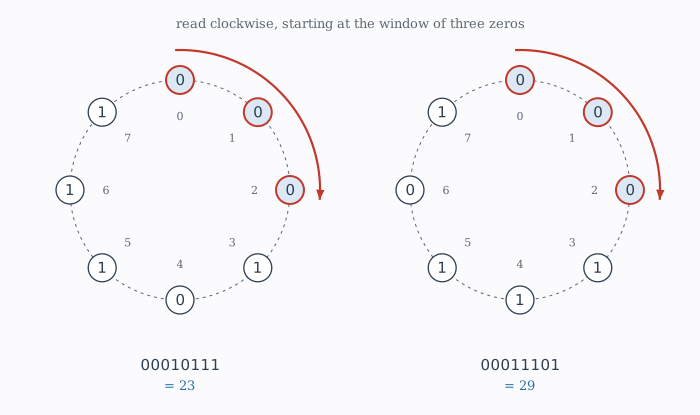
Binary Circles, Hamiltonian Cycles and de Bruijn Sequences
A small combinatorial puzzle about circular binary words whose windows are all distinct turns out to be a question about Hamiltonian cycles in de Bruijn graphs. I count the arrangements, sum their numeric encodings up to a word length of 64 bits, and end with the multiplication trick that uses such a word to locate a set bit.
-
The Weighted Linear Least Squares Algorithm
In this blog post, we are going to take a look at the so-called weighted linear least squares estimator, which is very similar to the ordinary linear least squares estimator, but with one slight modification: while the ordinary estimator assumes that the errors of all data points have the same variance (which is typically referred to as homoscedasticity) and therefore assigns the same weight to the errors in the objective function, the weighted counterpart allows us to weight every single error individually. This is especially interesting in cases where we are working in a heteroscedastic setting, that is, when the variability in the errors cannot be assumed to be the same.

-
Near-Perfect Connect-4 after Five Minutes of Training: Reinforcement Learning from Scratch by Self-Play
An n-tuple network learns Connect-4 from scratch by self-play on a single GPU and, after about five minutes of training, wins almost every game it starts against a perfect solver. Learning curves, results from both sides of the board, and how the training time was measured.