Binary Circles, Hamiltonian Cycles and de Bruijn Sequences
- The Problem
- A Graph on the Windows
- Hamiltonian Cycles, Eulerian Circuits and de Bruijn Sequences
- How many Circles there are
- A depth-first Search over the Windows
- Accumulating the Number during the Search
- The same Search in C with a 64-Bit visited Set
- Where the Ones sit in the Circle
- The smallest and the largest Circle
- An Application: finding the Position of a set Bit
- Limitations and open Ends
- Source Code
- References
Some time ago I worked through a small combinatorial exercise about binary digits arranged in a circle, and I recently came across the notebook again while looking for something else. The exercise itself is quickly stated and can be solved in a few lines of Python, but the object it produces has a name, a literature going back to the nineteenth century, and at least one application that I have used in completely unrelated code. That combination seemed worth a post: the puzzle is the excuse, and the structure behind it is the actual subject.
The plan is to first state the problem, then translate it into a question about walks in a directed graph, count the solutions with a classical theorem, and finally push the enumeration as far as my machine allows. Along the way we will see that the numbers produced by the puzzle have a good deal of internal structure, most of which is visible in the positions of the ones alone.
The Problem
Take \(2^N\) binary digits and arrange them in a circle. Reading clockwise and starting at any of the \(2^N\) positions yields a window of \(N\) consecutive digits, so such a circle offers exactly \(2^N\) windows, which is also the number of distinct binary strings of length \(N\). The question is whether the digits can be chosen so that all these windows are pairwise distinct. If they can, then by a counting argument every one of the \(2^N\) strings of length \(N\) occurs exactly once, including the window consisting of \(N\) zeros. Note that the length \(2^N\) is the largest one for which distinctness is possible at all, since a circle of length \(L\) has \(L\) windows and these can only be pairwise distinct if \(L \le 2^N\).
For \(N = 3\) there are two such circles, if we regard arrangements that differ only by a rotation as the same. Their windows, read clockwise from the position of the all-zero window, are \(000, 001, 010, 101, 011, 111, 110, 100\) in the first case and \(000, 001, 011, 111, 110, 101, 010, 100\) in the second.
Since each valid circle contains the all-zero window exactly once, we can use that window as a canonical starting point and encode the circle as a plain binary number: begin at the first digit of the all-zero window, walk clockwise, and read the \(2^N\) digits as the binary representation of an integer, most significant bit first. The encoding is well defined precisely because the starting point is unique, and it identifies all rotations of the same circle with each other. For \(N = 3\) the two arrangements become
\[\begin{align} 00010111_2 &= 23,\\ 00011101_2 &= 29. \end{align}\]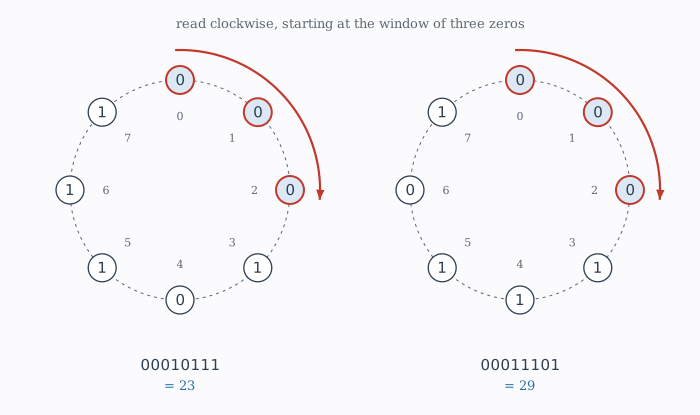
Writing \(S(N)\) for the sum of the encodings of all valid circles of length \(2^N\), we thus have \(S(3) = 23 + 29 = 52\). The quantity I originally wanted was \(S(5)\), which needs circles of \(32\) digits, and as we will see the same program also reaches \(S(6)\) with a bit of patience.
A Graph on the Windows
The condition that all windows are distinct is a global one, and it is not obvious how to search for such circles directly. It becomes much more tractable once we stop thinking about the circle and start thinking about the transition from one window to the next. If the current window is the \(N\)-bit string \(v\), then the next window clockwise is obtained by shifting \(v\) one position to the left, which discards its leading bit, and appending the next digit \(b\) of the circle, for example
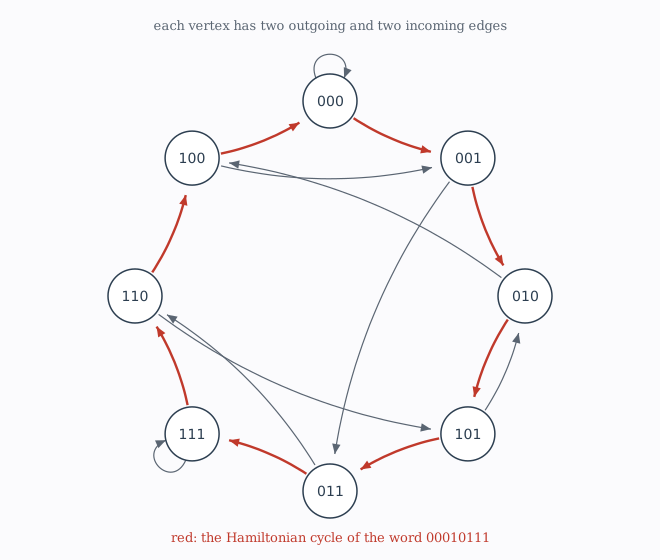
\[00101 \;\xrightarrow{\;b\,=\,1\;}\; 01011.\]Accordingly, we can define a directed graph whose \(2^N\) vertices are the \(N\)-bit strings and which has an edge from \(v\) to \(u\) whenever \(u\) can be reached from \(v\) in this way, that is, whenever the last \(N-1\) bits of \(v\) agree with the first \(N-1\) bits of \(u\). Every vertex then has exactly two outgoing edges (for the two possible choices of \(b\)) and, by the same argument applied backwards, exactly two incoming edges, so the graph has \(2^{N+1}\) edges in total. The two strings \(0\dots0\) and \(1\dots1\) carry a self-loop, since shifting them and appending the appropriate bit reproduces them.
In this language a valid circle is a closed walk that visits every vertex exactly once, in other words a Hamiltonian cycle. The digits of the circle are simply the labels of the traversed edges, and the encoding defined above is the concatenation of the leading bits of the visited vertices, starting at the all-zero vertex.
Hamiltonian Cycles, Eulerian Circuits and de Bruijn Sequences
The graph just constructed is the de Bruijn graph \(B(2,N)\), and the circular words we are after are the binary de Bruijn sequences of order \(N\). They are named after Nicolaas de Bruijn (de Bruijn, 1946), although the binary case had already been settled by Flye Sainte-Marie almost fifty years earlier (Sainte-Marie, 1894), a fact that was apparently forgotten in the meantime and only rediscovered later.
Searching for Hamiltonian cycles is in general an unpleasant business, but here there is a way around it. If we instead take the \((N-1)\)-bit strings as vertices and let every \(N\)-bit string be an edge (from its first \(N-1\) bits to its last \(N-1\) bits), we obtain the smaller graph \(B(2,N-1)\), and the requirement that every \(N\)-bit string occurs exactly once turns into the requirement that every edge is traversed exactly once. Hamiltonian cycles in \(B(2,N)\) therefore correspond one to one with Eulerian circuits in \(B(2,N-1)\), which is just the statement that \(B(2,N)\) is the line graph of \(B(2,N-1)\). Since \(B(2,N-1)\) is connected and every vertex has as many incoming as outgoing edges, Eulerian circuits are guaranteed to exist, and hence so are the circles we are looking for. Unlike the Hamiltonian problem, the Eulerian one is easy: a circuit can be built greedily in linear time, and it can also be counted.
How many Circles there are
The counting is done by the BEST theorem, named after de Bruijn, van Aardenne-Ehrenfest, Smith and Tutte (Tutte & Smith, 1941)(van Aardenne-Ehrenfest & de Bruijn, 1951). It states that in a connected digraph in which every vertex has equal in- and out-degree, the number of Eulerian circuits, counted up to their starting point and therefore with exactly the identification of rotations that our encoding performs, equals the number of spanning arborescences rooted at an arbitrary fixed vertex, multiplied by \(\prod_v (\deg v - 1)!\). For \(B(2,N-1)\) every out-degree is two, so all factorials are \(1! = 1\) and the count reduces to the number of arborescences alone, which in turn is a determinant of a reduced Laplacian by the matrix-tree theorem. For Eulerian digraphs that number does not depend on the chosen root, so the determinant can be taken at the most convenient vertex.
Carrying this out for the binary case gives
\[\begin{equation} M(N) = 2^{\,2^{N-1}-N} \label{eq:count} \end{equation}\]circles of length \(2^N\), so \(M(3) = 2\), \(M(4) = 16\), \(M(5) = 2048\) and already \(M(6) = 2^{26} = 67{,}108{,}864\). Rather than trusting the formula, I computed the determinant with exact rational arithmetic and compared it with the number of circles found by brute force:
def arborescences(m):
    """Spanning arborescences of B(2,m) rooted at vertex 0, by the matrix-tree theorem."""
    N = 1 << m
    idx = [v for v in range(N) if v != 0]
    pos = {v: i for i, v in enumerate(idx)}
    M = [[Fraction(0)] * len(idx) for _ in idx]
    for v in idx:
        M[pos[v]][pos[v]] = Fraction(2)
        for bit in (0, 1):
            u = ((v << 1) | bit) & (N - 1)
            if u != 0:
                M[pos[v]][pos[u]] -= 1
    # ... Gaussian elimination, returns the determinant as an integer
Both numbers agree for all orders up to \(N = 5\), which is as far as the enumeration is cheap. The growth is doubly exponential, and the consequence for the rest of this post is that \(N = 6\) with its \(67\) million circles is roughly where an exhaustive enumeration stops being comfortable: \(M(7)\) is already \(2^{57}\), or about \(1.4 \cdot 10^{17}\).
A depth-first Search over the Windows
The search itself is a textbook backtracking over the graph. We start at the all-zero vertex, repeatedly shift in a \(0\) or a \(1\), refuse any window that has been visited before, and record a solution whenever all \(2^N\) vertices have been used. My first version stored the visited windows as strings, which is slow but has the advantage that the search reads like the problem statement (the enclosing function that supplies n_bits is omitted here):
def search(last_substring, sequence, solutions):
    """Recursively extend a sequence with previously unseen substrings."""
    depth = len(sequence)

    # A complete sequence contains every possible n-bit substring once.
    if depth == 2**n_bits:
        solutions.append(sequence)
        return

    # Towards the end, only zeros are allowed so that the sequence
    # closes back onto the initial all-zero substring.
    bits = ("0", "1") if depth < 2**n_bits - n_bits + 1 else ("0",)

    for bit in bits:
        # Shift the current substring left and append the next bit.
        new_substring = last_substring[1:] + bit

        # Every n-bit substring may occur only once.
        if new_substring in sequence:
            continue

        search(new_substring, sequence + [new_substring], solutions)
The one part of this that deserves an explanation is the restriction of the alphabet near the end. A walk that has visited all vertices is not yet a solution: it also has to close, that is, the last vertex must have an edge back to the all-zero vertex. Only \(10\cdots0\) has such an edge, and working backwards, the vertex before it must be \(\ast10\cdots0\), the one before that \(\ast\ast10\cdots0\), and so on. All of these end in a zero, hence the last \(N-1\) edges of any solution carry the label \(0\). Seen from the circle rather than from the graph, this is not an extra insight at all: those \(N-1\) digits are the ones that wrap around the end of the word and coincide with the leading zeros of the all-zero window, so they were fixed from the very beginning. Hard-coding them merely saves the search from rediscovering the same fact \(2^{N-1}\) times.
Accumulating the Number during the Search
Collecting all solutions and converting them afterwards is wasteful, since the only thing we want is a sum. It is cheaper to build the value along the way: whenever a new window is appended, its leading bit is the next digit of the circular word, so the running value only has to be shifted once and combined with that bit. The visited set also no longer needs to be rebuilt at every node and can be maintained by adding and removing single elements:
def solve(n_bits: int) -> int:
    size = 1 << n_bits
    start = "0" * n_bits
    cutoff = size - n_bits + 1
    seen: set[str] = {start}
    total = 0

    def dfs(last_substring: str, depth: int, value: int) -> None:
        nonlocal total

        if depth == size:
            total += value
            return

        bits = ("0", "1") if depth < cutoff else ("0",)

        for bit in bits:
            new_substring = last_substring[1:] + bit
            if new_substring in seen:
                continue

            seen.add(new_substring)
            dfs(new_substring, depth + 1, (value << 1) | (new_substring[0] == "1"))
            seen.remove(new_substring)   # undo the choice when backtracking

    dfs(start, 1, 0)
    return total
On my rather elderly notebook (an Intel Core i7-3520M at 2.9 GHz, CPython 3.10) the first version takes between \(0.18\) and \(0.27\) seconds for \(N = 5\) and the second between \(0.09\) and \(0.11\) seconds, measured over three runs each. The factor of roughly two is pleasant but not dramatic, and both are far below the threshold where it would be worth thinking about.
What the runtimes hide is how effective the pruning is. Counting the nodes of the search tree gives \(23\) nodes for \(N = 3\), \(354\) for \(N = 4\) and \(92{,}636\) for \(N = 5\), against \(2\), \(16\) and \(2048\) solutions respectively. For \(N = 5\) that is about \(45\) nodes per solution while every solution is already \(32\) vertices deep, so the overwhelming majority of the visited nodes lie on paths that do lead somewhere. A dead end can only occur when both successors of the current window have already been used, and for \(N = 5\) this happens at \(11{,}562\) of the \(92{,}636\) nodes, so roughly one node in eight is a wasted branch.
The same Search in C with a 64-Bit visited Set
For \(N = 6\) the \(67\) million solutions are out of reach for CPython, but the problem has a property that makes a C implementation particularly compact: as long as \(N \le 6\), the number of windows is at most \(64\), so the entire set of visited windows fits into a single uint64_t. The test whether a window has been seen is then one shift and one AND, and marking and unmarking a window is a single OR and AND-NOT. The state of the search is held in four constants that are set once in main and three variables that change while the search runs:
static int n_bits;              /* window width n, between 2 and 6         */
static int n_windows;           /* 2^n windows, the vertices of the graph  */
static int window_mask;         /* 2^n - 1, cuts the shift register to n   */
static int forced_zeros_from;   /* from here on, only a 0 may be appended  */

static uint64_t used;           /* bit i is set if window i is in the walk */
static unsigned __int128 sum_of_circles;
static uint64_t n_circles, n_nodes;
For the largest case that this program handles, \(N = 6\), these hold n_bits \(= 6\), n_windows \(= 64\), window_mask \(= 63\) and forced_zeros_from \(= 59\), while used starts out as \(1\), because the walk begins on the all-zero window, which is window number \(0\). The recursion itself carries three arguments and is called as dfs(0, 1, 0):
static void dfs(int window, int placed, uint64_t digits) {
  n_nodes++;
  if (placed == n_windows) {    /* all windows used, the circle is complete */
    sum_of_circles += digits;
    n_circles++;
    return;
  }

  /* The last n-1 digits of every circle are the zeros that wrap around. */
  int max_digit = (placed >= forced_zeros_from) ? 0 : 1;

  for (int digit = 0; digit <= max_digit; digit++) {
    /* shift the window one position on and append the new digit */
    int next_window = ((window << 1) | digit) & window_mask;

    if (used >> next_window & 1) continue;          /* window already taken */
    used |= (uint64_t)1 << next_window;

    /* the digit dropped by the shift is the next digit of the circle */
    dfs(next_window, placed + 1,
        (digits << 1) | (uint64_t)(next_window >> (n_bits - 1)));

    used &= ~((uint64_t)1 << next_window);          /* undo when backtracking */
  }
}
The three Arguments and what they hold
The argument window is the window the walk currently stands on, stored as the integer that its \(N\) digits form, so for \(N = 5\) it is a number between \(0\) and \(31\). The argument placed counts how many windows have been placed so far, including the all-zero window the search starts on, and therefore runs from \(1\) up to n_windows. The argument digits is the part of the circular word that is already determined, again read as a binary number, and the invariant is that after placed windows it holds the first placed digits of the circle. When the first branch of the function is taken, digits consequently contains the complete encoding of a valid circle and can be added to the sum without any conversion.
The visited set used is a global rather than a fourth argument, because it is the only piece of state that has to be undone when the recursion returns. The other three unwind by themselves, since each stack frame keeps its own copy.
The Window as a Shift Register
The line
int next_window = ((window << 1) | digit) & window_mask;
performs the transition of the graph in three operations. Shifting left moves the window one position clockwise, the OR appends the new digit at the right end, and the AND with window_mask discards the digit that has been pushed out at the left end. This is precisely the edge relation described earlier, namely that the last \(N-1\) digits of window are the first \(N-1\) digits of next_window. The window therefore behaves exactly like a shift register of width \(N\) that is clocked once per digit of the circle.
Because next_window is itself a number below \(2^N \le 64\), it can serve directly as a bit index into used. The test used >> next_window & 1 parses as (used >> next_window) & 1 and asks whether that window is already part of the walk, the OR marks it before descending, and the AND with the complement clears it again once the branch is exhausted. The casts to uint64_t in the two marking lines are not cosmetic: for \(N = 6\) the shift count reaches \(63\), and shifting a plain int that far is undefined behaviour, so leaving the cast out would produce a bug that only shows up in the largest case.
Why the leading Bit of the new Window is the next Digit
The digit that the search chooses in the loop is not the next digit of the answer, since it belongs to a window further ahead in the circle. The digit that is finished at this moment is the one that falls off at the left, which is the leading bit of the new window, obtained as next_window >> (n_bits - 1). Put differently, the digits discarded by the shift register, in the order in which they are discarded, are the circular word itself, and this is why one shift and one OR are enough to maintain digits. Writing the first of the two solutions for \(N = 3\) as \(w_0w_1\dots w_7 = 00010111\), the first four steps run as follows:
placed | window | corresponds to | leading bit | digits |
|---|---|---|---|---|
| 1 | 000 | \(w_0w_1w_2\) | 0 | |
| 2 | 001 | \(w_1w_2w_3\) | \(w_1 = 0\) | 00 |
| 3 | 010 | \(w_2w_3w_4\) | \(w_2 = 0\) | 000 |
| 4 | 101 | \(w_3w_4w_5\) | \(w_3 = 1\) | 0001 |
The forced Zeros and the missing Closure Test
The assignment int max_digit = (placed >= forced_zeros_from) ? 0 : 1; lets the loop run over both digits during the ordinary part of the search and over the digit \(0\) alone during the last \(N-1\) steps. As discussed above, those digits are the ones that wrap around the end of the word onto the leading zeros of the all-zero window, so they were fixed before the search started.
This also explains why the function never tests whether the walk closes. After \(N-1\) forced zeros the final window ends in \(N-1\) zeros, and since the all-zero window has been taken since the very first step, that window can only be \(10\cdots0\), which does have an edge back to the start. Should one of the forced steps run into a window that is already in use, the branch dies at the continue and never reaches placed == n_windows. Arriving at the terminal case is therefore equivalent to having found a closed circle, and no separate check is needed.
Range of the Accumulator and Measurements
The accumulator needs some care. A circle of \(64\) digits whose first six digits are zero encodes a number below \(2^{58}\), and summing \(2^{26}\) such numbers can reach \(2^{84}\), so sum_of_circles is declared as an unsigned __int128 and printed digit by digit, since there is no format specifier for it. With gcc -O2 on the same machine, the run for \(N = 5\) finishes in about a millisecond, and the run for \(N = 6\) visits \(5{,}504{,}163{,}339\) nodes and takes between \(58\) and \(86\) seconds over three runs, depending on what else the machine was doing at the time, which corresponds to something between \(64\) and \(95\) million nodes per second on a single core. The results are
| \(N\) | digits \(2^N\) | circles \(M(N)\) | \(S(N)\) |
|---|---|---|---|
| 2 | 4 | 1 | 3 |
| 3 | 8 | 2 | 52 |
| 4 | 16 | 16 | 51,504 |
| 5 | 32 | 2,048 | 209,110,240,768 |
| 6 | 64 | 67,108,864 | 14,617,787,158,279,466,864,345,088 |
and the values of \(M(N)\) obtained by counting agree with \eqref{eq:count} in every case, which is a reassuring cross-check on both the formula and the search. The Python and the C program produce identical node counts and identical sums for \(N \le 5\).
Where the Ones sit in the Circle
Since the encoding is a positional number, the sum \(S(N)\) can be written as
\[\begin{equation} S(N) = \sum_{i=0}^{L-1} c_i \, 2^{\,L-1-i}, \qquad L = 2^N, \label{eq:positions} \end{equation}\]where \(c_i\) is the number of circles that carry a one at position \(i\). These counts are worth looking at, because several of them are fixed by the problem alone. The first \(N\) digits are the all-zero window, so \(c_0 = \dots = c_{N-1} = 0\). The digit at position \(N\) must be a one, because otherwise the window starting at position \(1\) would be a second all-zero window, hence \(c_N = M(N)\). The same argument applied to the window that starts at the last position, which reads \(w_{L-1}0\cdots0\) after wrapping around, forces the last digit to be a one as well, so \(c_{L-1} = M(N)\). Finally, every circle contains exactly \(2^{N-1}\) ones, since the ones are in bijection with the windows that begin with a one.
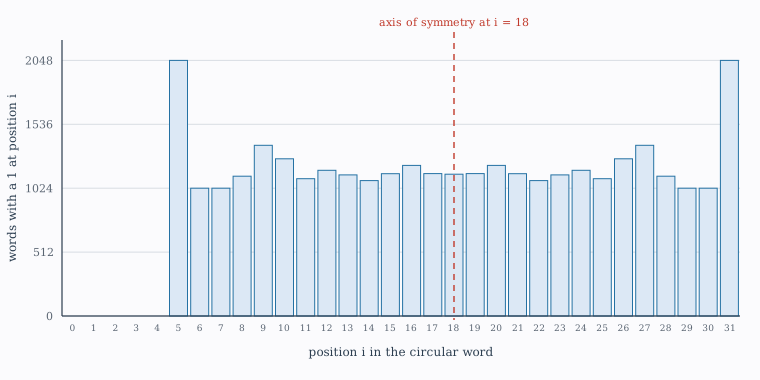
The plot shows a clear symmetry, and the reason is that reversing a circular word preserves the property we are interested in: reading the windows backwards turns every window into its reverse, and distinct windows stay distinct. Reversal does move the all-zero window, however, so the reversed word has to be rotated back into canonical form. If the original word is \(w_0 w_1 \dots w_{L-1}\) with \(w_0 = \dots = w_{N-1} = 0\), the canonical reversal is \(w'_j = w_{(N-1-j) \bmod L}\), which maps position \(i\) to position \((N-1-i) \bmod L\). The counts must therefore satisfy \(c_i = c_{N-1-i \bmod L}\), which for \(i \ge N\) is exactly the palindrome visible in the figure, with the axis at \(i = (N+L-1)/2\). For \(N = 4\) the counts are small enough to print,
\[(c_i)_{i=0,\dots,15} = (0,0,0,0,\;16,8,10,13,6,11,11,6,13,10,8,16),\]and the palindrome from position \(4\) onwards is easy to check by eye. Complementing all digits is a second symmetry of the same kind, and both were verified against the enumerated solutions for all \(N \le 5\), as was identity \eqref{eq:positions}. The counts do not, unfortunately, seem to follow a pattern that would let one compute \(S(N)\) without enumerating the circles: apart from the fixed positions and the symmetry, the numbers \(1120, 1368, 1260, 1100, \dots\) for \(N = 5\) look thoroughly irregular to me.
The smallest and the largest Circle
Two of the circles can be written down without any search. The smallest encoding is the lexicographically least de Bruijn sequence, and it is obtained by concatenating, in lexicographic order, all Lyndon words over \(\{0,1\}\) whose length divides \(N\) (Fredricksen & Maiorana, 1978). A Lyndon word is a word that is strictly smaller than all of its own rotations, and Duval’s algorithm generates the required ones in a few lines. For \(N = 5\) the Lyndon words are
\[0,\; 00001,\; 00011,\; 00101,\; 00111,\; 01011,\; 01111,\; 1,\]and their concatenation is \(00000100011001010011101011011111\), that is \(73{,}743{,}071\), which is indeed the smallest value the enumeration produces. The largest encoding, \(131{,}913{,}257\), is produced by the opposite greedy rule: start at the all-zero window and always append a one if the resulting window has not been used yet. Both rules were checked against the full enumeration for \(N \le 5\). It is tempting to guess that the largest circle is simply the reverse of the smallest one, which is true for \(N = 3\), where \(23\) and \(29\) are reverses of each other, but it already fails for \(N = 4\) and \(N = 5\).
An Application: finding the Position of a set Bit
The reason I remembered these words at all is that they show up in bit manipulation. Suppose a \(64\)-bit variable has exactly one bit set and we want its index. In an earlier post on bit-twiddling tricks I used a divide-and-conquer routine for this, which narrows the position down in six steps. There is an alternative that needs one multiplication, one shift and one table lookup (Leiserson et al., 1998), and its magic constant is precisely a de Bruijn word of order six. Taking the smallest such word from the previous section, \(0000001000011000101000111001001011001101001111010101110110111111\), gives the constant 0x0218a392cd3d5dbf, and the routine becomes
static const uint64_t DEBRUIJN64 = 0x0218a392cd3d5dbfULL;
static int index64[64];

static void init_table(void) {
  for (int k = 0; k < 64; k++)
    index64[(DEBRUIJN64 << k) >> 58] = k;
}

static int bit_pos(uint64_t x) {   /* x must have exactly one bit set */
  return index64[(x * DEBRUIJN64) >> 58];
}
The same Trick in eight Bits
The \(64\)-bit constant is unreadable, so it is easier to watch the mechanism in the small case, with the order-3 word \(00010111\) from the beginning of this post as an eight-bit constant and the topmost three bits kept after each shift:
| \(k\) | the constant shifted left by \(k\) | top three bits |
|---|---|---|
| 0 | 00010111 | 000 |
| 1 | 00101110 | 001 |
| 2 | 01011100 | 010 |
| 3 | 10111000 | 101 |
| 4 | 01110000 | 011 |
| 5 | 11100000 | 111 |
| 6 | 11000000 | 110 |
| 7 | 10000000 | 100 |
The right-hand column runs through all eight three-bit patterns without repeating one, and this is no accident: those patterns are the eight windows of the circle, read in the order in which they occur. Shifting left by \(k\) moves the window that starts at position \(k\) to the top of the register, and since the windows of a de Bruijn word are pairwise distinct, the topmost bits are a fingerprint that identifies the shift amount uniquely.
One detail is worth pausing on, since it explains why the constant has to be in the canonical form that the puzzle uses. A shift is not a rotation, and it pulls in zeros from the right instead of the digits that wrap around the circle. For \(k = 6\) the genuine circular window would be \(w_6w_7w_0 = 110\) while the register contains \(w_6w_70 = 110\), and for \(k = 7\) the circular window \(w_7w_0w_1 = 100\) meets the register’s \(w_700 = 100\). Both agree because the word begins with \(N\) zeros, so the zeros entering from the right are exactly the digits that would have wrapped. Any de Bruijn word normalised the way the encoding of this post normalises it, that is, starting at its all-zero window, therefore serves as a constant, whereas an arbitrary rotation of one does not.
Building the Table and reading it back
init_table walks that table forward once and stores each shift amount under its fingerprint. The shift by \(58 = 64 - 6\) keeps the topmost six bits, which is the window width belonging to a \(64\)-bit constant, and because all \(64\) fingerprints are distinct, the loop fills all \(64\) slots of index64 without a single collision. The array is thus a perfect hash table that is constructed rather than searched for.
The function bit_pos then inverts that map. If x has exactly one bit set, say bit \(k\), then x * DEBRUIJN64 is the same thing as DEBRUIJN64 << k, because multiplying by \(2^k\) is a left shift by \(k\) positions. The topmost six bits of the product are therefore the fingerprint that init_table has already filed under \(k\), and the lookup hands \(k\) back. The multiplication is the entire trick: it performs a shift whose amount is not known in advance, which is precisely the quantity we are looking for.
A worked Example
Let the bit in question be bit \(10\), so that x is \(2^{10} =\) 0x400. While the table was built, the iteration \(k = 10\) computed DEBRUIJN64 << 10 = 0x628e4b34f576fc00, whose top six bits are 011000, that is \(24\), and it therefore set index64[24] = 10. At lookup time, bit_pos(0x400) multiplies \(2^{10}\) by the constant, arrives at the same 0x628e4b34f576fc00, shifts it right by \(58\) to obtain \(24\) again, and reads index64[24], which is \(10\).
The product overflows, and the overflow is needed rather than tolerated: \(2^{10}\) times the constant does not fit into \(64\) bits, and reducing it modulo \(2^{64}\) discards exactly those bits that a shift would have pushed out of the register. C defines this wraparound for unsigned arithmetic, which is why both the constant and the argument are uint64_t; with a signed type the same code would be undefined behaviour.
Practical Remarks
The routine insists on exactly one bit being set, and the usual way to arrange that is to call it as bit_pos(v & -v), since v & -v isolates the lowest set bit of v, so that the two together count the trailing zeros. Whether this is faster than the divide-and-conquer version depends on the machine, as it trades six dependent steps for one multiplication, one shift and one cached load, and on anything recent one would use a compiler intrinsic such as __builtin_ctzll instead, which maps to a single instruction. What I find appealing is that the enumeration above is not only a puzzle solver but also a generator for these constants: the table produced from its smallest solution is correct for all \(64\) positions, which I verified by running bit_pos on every power of two.
Limitations and open Ends
The main limitation is the doubly exponential growth. Every step from \(N\) to \(N+1\) squares the number of circles, so \(S(7)\) would require about \(1.4 \cdot 10^{17}\) of them. Assuming a similar number of search nodes per circle as for \(N = 6\), that is roughly \(10^{19}\) nodes, and even at the fastest rate measured above it would keep a single core busy for a few thousand years. The bitset trick also stops at \(N = 6\), since \(128\) windows no longer fit into a machine word. Neither is a real obstacle for the original question, but it does mean that \(S(N)\) is, as far as I can see, only accessible by enumeration, whereas the number of circles \(M(N)\) has the closed form \eqref{eq:count}. I spent a while looking for a way to compute the position counts \(c_i\) directly, for instance by counting Eulerian circuits that use a given edge at a given step, but did not find anything that beats enumeration; if such a method exists, it would immediately give \(S(7)\) and beyond.
A second open end concerns the symmetries. Reversal and complementation both act on the set of circles, and for \(N \le 5\) neither has a fixed point apart from the trivial case \(N = 2\). The orbits of these two involutions would halve or quarter the work of an enumeration, but only if one could decide cheaply which representative to keep, and the canonical rotation that the encoding requires makes that less straightforward than it sounds.
Source Code
The notebook this post grew out of contains the two Python versions shown above. The C enumerator, the matrix-tree cross-check, the Lyndon word construction, the bit-scan test and the scripts that produce the figures are kept next to the sources of this site in tools/debruijn/. All numbers quoted in this post come from running exactly that code on the machine described above.
References
- A Combinatorial ProblemProceedings of the Koninklijke Nederlandse Akademie van Wetenschappen, 1946
- Solution to question nr. 48L’Intermédiaire des Mathématiciens, 1894
- On Unicursal Paths in a Network of Degree 4The American Mathematical Monthly, 1941
- Circuits and Trees in Oriented Linear GraphsSimon Stevin, 1951
- Necklaces of Beads in k Colors and k-ary de Bruijn SequencesDiscrete Mathematics, 1978
- Using de Bruijn Sequences to Index a 1 in a Computer Word1998
Related posts: The routine for locating a single set bit, and a few other techniques for working with bit fields, are discussed in A few Bit-Twiddling Tricks. For another exhaustive search that only became feasible after the state was packed into machine words, see Solving Peg Solitaire.
Enjoy Reading This Article?
Here are some more articles you might like to read next: